Radio Marien
Led by Father Guillermo Perdomo, S.J., this radio station broadcasts programs (such as educational programs, Sunday masses, news etc.) which aim at improving the lives of the people in the community. As per the words of Father Guillermo: “The radio is the internet of the poor”. In fact, the new Bishop who came to Dajabon in 2006 described Radio Marien as “the educators of the border”. Moreover, this organization has created awareness campaigns in the past to help protect people from malaria and have instructed the community instructing people in the proper of bed nets.
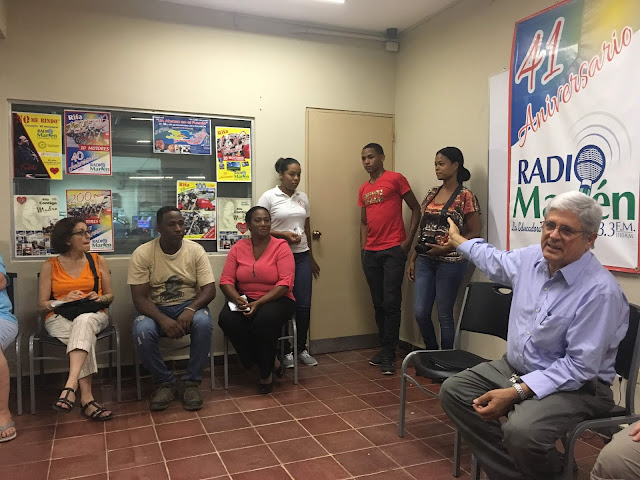 |
| Father Guillermo Perdomo, S.J. presenting Radio Marien to our group |
 |
Our group with members of the staff of Radio Marien
During our visit to Radio Marien, we also had the opportunity to introduce ourselves on the radio and to explain the reason of our visit to the Dominican Republic and Haiti.
|
Lakay Jezi in Ouanaminthe, Haiti
Ultimately, the main objective of Father Mario is to help the children who come to Hogar de Cristo integrate back to Haiti so that they can go to school and learn a trade. Therefore, he founded another shelter in Ouanaminthe (Haiti) called “Lakay Jezi”, which we also had the opportunity to visit. The children we met there were formerly street children in Dajabon and thanks to the support of the youth shelter, they are going to school and some of them are working.
 |
| The neighbourhood of Lakay Jezi in Ouanaminthe (Haiti) |
 |
| The neighbourhood of Lakay Jezi in Ouanaminthe (Haiti) |
 |
| The neighbourhood of Lakay Jezi in Ouanaminthe (Haiti) |
 |
| The neighbourhood of Lakay Jezi in Ouanaminthe (Haiti) |
 |
| The children at Lakay Jezi performing a song to welcome us |
 |
In the backyard of Lakay Jezi
|
 |
| The children in the neighborhood were curious to see who was visiting Lakay Jezi |
 |
| The children at Lakay Jezi spending time with us outside |
 |
| The house rules at Lakay Jezi |
 |
| Children at Lakay Jezi sharing with us their stories and their hopes and dreams for the future |
 |
| Children at Lakay Jezi sharing their stories and their hopes and dreams for the future with us |
 |
| View from the rooftop of Lakay Jezi |
 |
| Fouedlin showing me around the house |
 |
| The immersion program participants with the kids and staff of Lakay Jezi |
Solidarité Fwontalye
The jesuit organizations Solidarité Fwontalye and Fe y Alegria/Foi et Joie also work closely with children and communities in Ouanaminthe, Haiti. For instance, the Solidarité Fwontalye centre works for the local communities by developing agricultural and other activities that empower people and help them earn a living. The centre hopes that these activities will discourage people from migrating out of necessity. It also informs the local communities about the risks of irregular migration through its radio program and provides legal assistance to those in need.
 |
Presentation from Robinson who is a Jesuit Scholastic
|
 |
| In front of Solidarité Fwontalye |
Fe y Alegria/Foi et Joie schools
Fe y Alegría/Foi et Joie schools have been in Haiti since 2006. The main purpose of these Jesuit schools is to establish themselves in places where there is no school. “Where the pavement stops, Fe y Alegría begins”. It also aims at advocating and providing “Quality education for the poor”. There are currently 17 of those schools in Haiti; 5 in the Ouanaminthe region. In these 17 schools, there are about 5000 students and 300 teachers (237 boys, 2492 girls). Due to challenges in recruiting teachers, the centre sends promising and interested people to teaching school for training.
 |
| Two amazing Foi et Joie students in Haiti who approached me |
 |
Marius the Coordinator for Foi et Joie in Bedou, Haiti
|
 |
| Marius introducing us to his staff |
 |
| Visiting the students at one of the Foi et Joie schools in Bedou, Haiti |
 |
| Inside one of the classrooms |
 |
| Me and some students of Foi et Joie |
Typically the education model of Fe y Alegria/Foi et Joie schools requires a partial financial contribution from the government and contribution from fundraising activities to help pay for the teachers’ salaries and to pay the running costs of the schools. However, the Fe y Alegria/Foi et Joie schools in Haiti experience more difficulties in receiving financial contribution from the government. Therefore, the Jesuits work with lay people, other religious congregations and even evangelical churches to run schools. They also seek the help of private fundraisers for construction projects.


Comments
Post a Comment